Begin of page section:
Page sections:

  • Go to contents (Accesskey 1)
  • Go to position marker (Accesskey 2)
  • Go to main navigation (Accesskey 3)
  • Go to sub navigation (Accesskey 4)
  • Go to additional information (Accesskey 5)
  • Go to page settings (user/language) (Accesskey 8)
  • Go to search (Accesskey 9)

End of this page section. Go to overview of page sections

Begin of page section:
Page settings:

English en
Deutsch de
Search
Login

End of this page section. Go to overview of page sections

Begin of page section:
Search:

Search for details about Uni Graz
Close

End of this page section. Go to overview of page sections


Search

Begin of page section:
Main navigation:

Page navigation:

  • University

    University
    • About the University
    • Organisation
    • Faculties
    • Library
    • Working at University of Graz
    • Campus
    Developing solutions for the world of tomorrow - that is our mission. Our students and our researchers take on the great challenges of society and carry the knowledge out.
  • Research Profile

    Research Profile
    • Our Expertise
    • Research Questions
    • Research Portal
    • Promoting Research
    • Research Transfer
    • Ethics in Research
    • Commission for Scientific Integrity
    Scientific excellence and the courage to break new ground. Research at the University of Graz creates the foundations for making the future worth living.
  • Studies

    Studies
    • Prospective Students
    • Students
  • Community

    Community
    • International
    • Location
    • Research and Business
    • Alumni
    The University of Graz is a hub for international research and brings together scientists and business experts. Moreover, it fosters the exchange and cooperation in study and teaching.
Topics
  • Sustainable University
  • Researchers answer
  • Work for us
Close menu

End of this page section. Go to overview of page sections

Begin of page section:
You are here:

University of Graz Natural sciences Institute of Chemistry News Biologische Brücken bauen: Chemikerin findet ökologisches Werkzeug für Pharmaindustrie
  • About the institute
  • Our Research
  • Study service
  • Personalities
  • News

End of this page section. Go to overview of page sections

Wednesday, 22 April 2026

Building biological bridges: Chemist discovers an ecological tool for the pharmaceutical industry

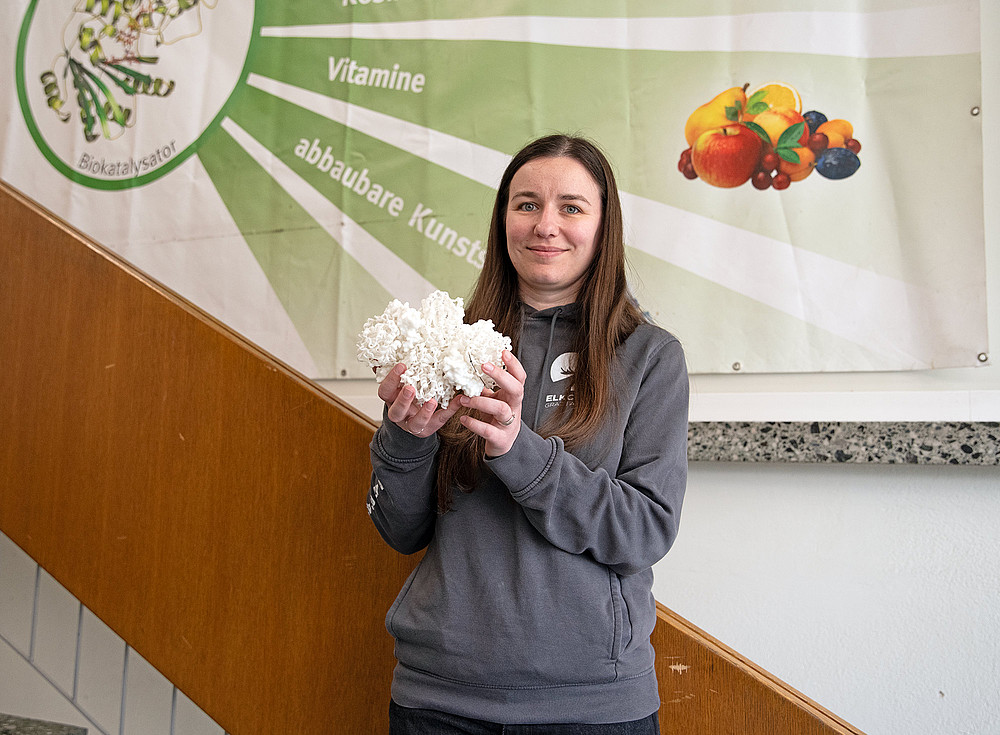
Lilla Gal holds a model of the enzyme she discovered

A natural tool for sustainable production: Lilla Gal has discovered a new enzyme for the production of medicines or disinfectants and has deciphered its structure. Photo: University of Graz/Eklaude

Building a relationship on a solid foundation is also important in chemistry. To produce medicines, disinfectants or plant protection products, stable bonds between carbon atoms must be formed. Conventional chemical methods rely on environmentally harmful reagents and solvents to carry out the desired reaction. This process also produces unusable by-products. Chemist Lilla Gal has discovered an enzyme that enables the same process to take place efficiently and sustainably. The results of her research were recently published in the prestigious journal Angewandte Chemie.

“The enzyme we have discovered and are using in our research is produced by a bacterium,” explains Lilla Gal. The reaction requires nothing more than an aqueous solution and temperatures of around 30 degrees Celsius – so no chemicals or large amounts of energy are needed. The newly discovered tool can, for example, produce a substance for a malaria drug in a single step, and without any by-products whatsoever. “Conventional methods generate around 60 per cent waste. This perfect result surprised even us,” reports Gal’s PhD supervisor, Wolfgang Kroutil.
The enzyme can also be used for the production of antifeedants or antibacterial compounds. In the next step, Gal is now attempting to enable the production of further chemical compounds by manipulating the tool.

Gal’s project is part of the European Marie Curie Training Network “BioDeCCodiNNg”, which focuses on finding new and more environmentally friendly ways to create bonds between atoms. The focus is on bonds between carbon or nitrogen atoms. Enzymes, nature’s tools, can usually facilitate such reactions in a particularly environmentally friendly and efficient manner.
Publication:
Lilla Gal, Suresh Rohan, Anna Zadlo-Dobrowolska, Bianca Hilweg, Judith Müller, Kai Tittmann, Wolfgang Kroutil: Biocatalytic Regioselective C-Formylation of Resorcinol Derivatives, Angewandte Chemie Volume 65, Issue 10

created by Dagmar Eklaude

Related news

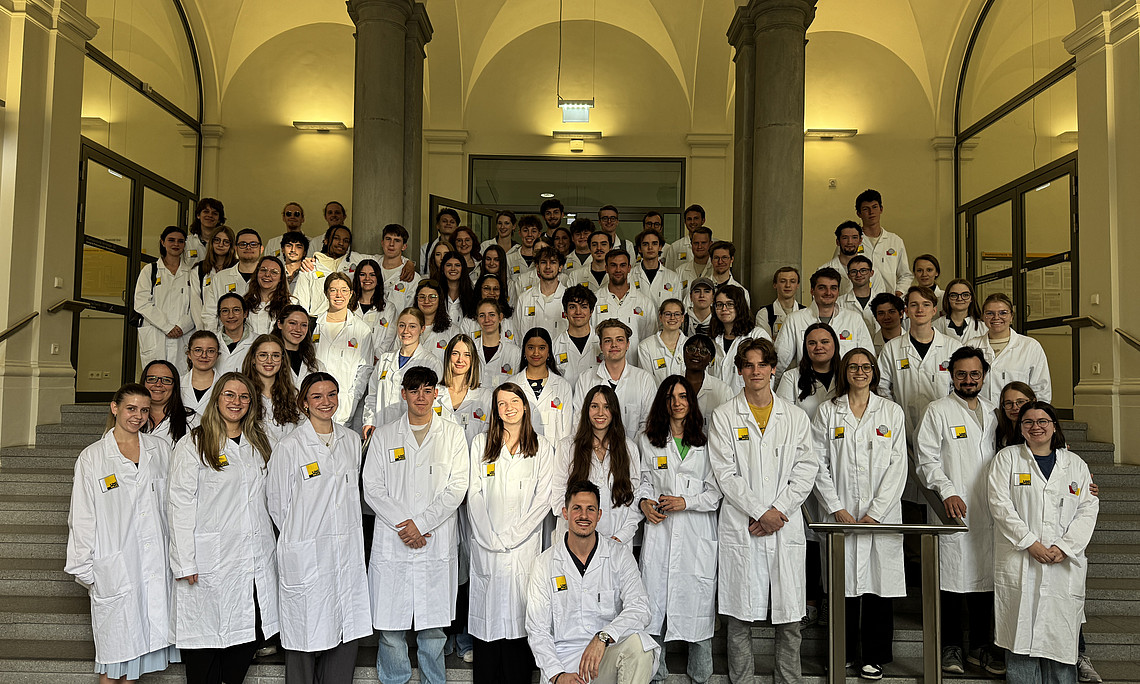
Premiere am Institut für Chemie: Erste LabCoat-Ceremony

Mit der ersten LabCoat-Ceremony am 27. Mai 2025 begrüßte das Institut für Chemie feierlich seine neuen Studierenden. Im festlichen Rahmen erhielten sie ihren offiziellen, mit dem Universitätslogo bestickten Labormantel – das Symbol ihres Starts als Nachwuchschemikerinnen und -chemiker.

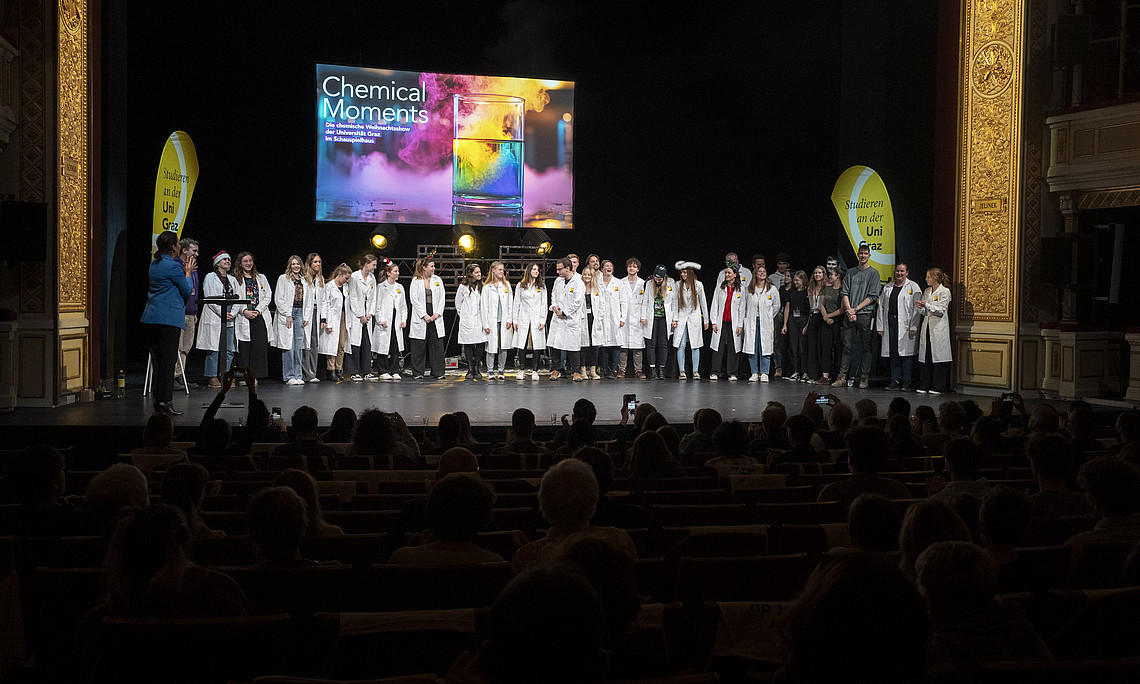
Students at the University of Graz provided enchanting moments full of chemistry

Themed ‘Chemical Moments’, the chemical Christmas show at the University of Graz enchanted the audience with glowing experiments, fiery reactions and creative research. Around 500 high school students experienced an evening full of scientific highlights and fascinating chemistry at the Schauspielhaus Graz at the end of November.

Even greener: University of Graz researchers improve the chemical industry

Durable bioplastics, rapidly available medicines or cosmetics without toxic waste materials: chemists have long relied on enzymes, i.e. proteins from nature, as biocatalysts for environmentally friendly production. Researchers from the University of Graz and the Austrian Center of Industrial Biotechnology, together with BASF, have now discovered how they can determine the ideal conditions for production to make it even more sustainable. The results have been published in the journal Nature Communications.

University of Graz develops sustainable and recyclable bio-plastic

Researchers at the University of Graz are developing a fully recyclable, bio-based epoxy resin that could change the plastics industry in the long term. A breakthrough that combines environmental protection and economic efficiency.

Begin of page section:
Additional information:

University of Graz
Universitaetsplatz 3
8010 Graz
Austria
  • Contact
  • Web Editors
  • Moodle
  • UNIGRAZonline
  • Imprint
  • Data Protection Declaration
  • Accessibility Declaration
Weatherstation
Uni Graz

End of this page section. Go to overview of page sections

End of this page section. Go to overview of page sections

Begin of page section:

End of this page section. Go to overview of page sections